
Mobile App Development
Native and cross platform apps built to launch fast and scale without a rebuild. A disciplined first version, store submission handled, and the code, repository and accounts handed to you.

What it is, and why it matters
App projects rarely fail on code. They fail on scope. A first version grows to forty screens because every stakeholder adds the one thing they need, the budget goes on features nobody has validated, and the launch date slips until the idea has gone cold.
So the most valuable thing we do happens before development starts: agreeing what version one is, and being blunt about what waits. A small app that ships and gets used teaches you more in a month than a large one still in build after six.
After that it is ordinary engineering discipline. Cross platform where it saves money and native where it genuinely does not, analytics from the first build so you can see what people actually open, and a release process your team can run without us.
Who this is for
A good fit if
- There is one thing users will open the app to do, and you can name it
- You have a budget for after launch, not just up to it
- Someone on your side can make product decisions quickly
- The app does something a mobile website genuinely cannot
Probably not if
- The requirement is a list of features with no agreement on which comes first
- A responsive website would do the same job, which is true more often than people expect
- There is no budget for maintenance, where the real cost lives
- You need it in four weeks with a fixed feature list
What is included
| Deliverable | How often |
|---|---|
| Product discovery and scope definition | Onboarding |
| User flows and wireframes | Project |
| Interface design for both platforms | Project |
| Cross platform build, iOS and Android | Project |
| Fully native build where needed | Project |
| Backend, APIs and integrations | Project |
| Payments and third party services | Project |
| QA on real devices | Every release |
| Store submission and review handling | Every release |
| Crash reporting and usage analytics | From first build |
| Maintenance and OS update support | Monthly, after launch |
How it fits together
Your first 90 days
- Weeks 1 to 2
Agree what version one is
We map the flows, cut the scope to what earns its place, and write it down in a document both sides sign. Everything that gets cut goes on a list rather than into a bin, so nobody feels overruled.
- Weeks 3 to 4
Design what users will touch
Flows and screens are designed and clicked through as a prototype before code starts. Changing a screen here takes an hour. Changing it after the build takes a release.
- Weeks 5 to 9
Build in visible increments
You get a testable build every fortnight on your own device, not a demo at the end. Analytics and crash reporting go in from the first build, so the first real users are measurable.
- Weeks 10 to 12
Test on real devices, then submit
QA runs on actual hardware across a range of versions, not just a simulator. We handle both store submissions and any review rejections, which are routine and usually about metadata rather than code.
What you actually receive
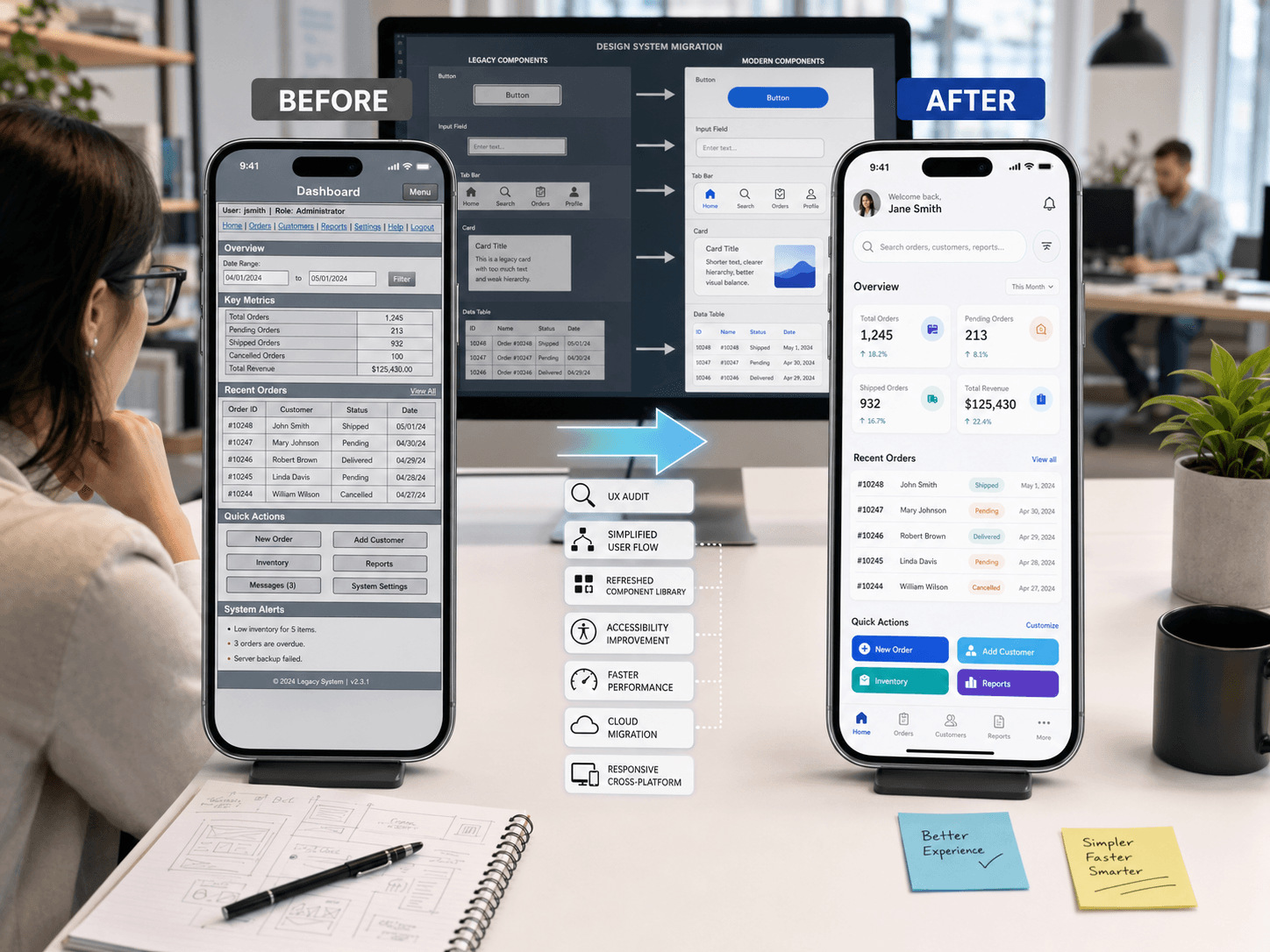
The scope document is the deliverable that matters most. Every screen, every state, what is in version one and what is explicitly not, with the reasoning next to each cut.
It is what we both point at when someone asks for a new feature in week six, which is the week someone always does.
- Every screen in version one, with its states
- What was cut, and what would trigger building it
- Third party services, and who pays for each
- The release plan, including who can publish updates
Metrics we move
Crash free sessions
Above 99 percent at launch
Crash reporting, per release, both platforms
Day seven retention
The honest signal of whether it is useful
Users returning a week after install
Time to core action
Shortened release by release
From app open to the thing users came to do
Release cadence
Predictable rather than heroic
Days between a fix being merged and being live
Where this usually goes wrong
The usual mistake: Building every stakeholder's feature into version one so nobody feels left out.
What we do instead: Ship the core, measure it, and let usage decide what version two contains.
The usual mistake: Building an app because competitors have one, when a fast mobile site would do the job.
What we do instead: Apps earn their place through repeat use, notifications or device features. If none apply, save the money.
The usual mistake: Treating launch as the finish line and budgeting nothing beyond it.
What we do instead: Plan for maintenance. OS updates alone will break something within a year, guaranteed.
The usual mistake: Registering store accounts under the agency, which happens more often than it should.
What we do instead: Both developer accounts in your company name from day one. Recovering them later is painful.
Questions we get asked
How do we get started?
Book a free consultation. We look at where things stand today, agree what to fix first, and send a written scope before any work begins.
How is the cost decided?
Every engagement is scoped to your goals, the size of the work and your timeline. You get a written proposal after the consultation, so the cost is clear before anything starts.
How will we know it is working?
We agree the measures at the start, then report against them in plain language, with the numbers shown so you can check them yourself.
Who will we work with?
A named lead who knows your account, backed by the specialists the work needs. You always know who to message.
Do you work in Arabic as well as English?
Yes. Content, campaigns and reporting can run in Arabic, in English, or in both, depending on who your customers are.
Can you work alongside our own team?
Yes. We can take on the whole service or fill the gaps around your in house team, and hand over cleanly if that ever changes.
What do you need from us?
Access to the accounts involved, one person who can approve work, and an honest picture of what has been tried before.
Explore our other services
- SEO, GEO & AEORank for what buyers search, and get cited by the AI answers they ask instead.Explore the service
- Local SEOGet found on Google Maps and in near me searches across Dubai and the UAE.Explore the service
- Performance MarketingCampaigns measured on pipeline and revenue, not impressions and reach.Explore the service
- Google Ads ManagementSearch, shopping and display, run tight so the budget lands on buyers.Explore the service
- Meta Ads ManagementFacebook and Instagram campaigns built around creative that keeps working.Explore the service
- Social Media ManagementAn always on presence, planned and produced so the calendar never runs dry.Explore the service
- Content CreationCopy and assets that answer real questions and earn the click.Explore the service
- Website Design & DevelopmentA digital home that attracts new customers and turns visits into enquiries.Explore the service
- Photography & VideographyShoots produced in house, from product stills to full brand films.Explore the service
- Online Reputation ManagementControl what people find when they check you, and keep the reviews honest.Explore the service
- Branding & Public RelationsPositioning, identity and the press coverage that makes people take you seriously.Explore the service
- Telecalling ServicesTrained agents working your leads so nothing sits waiting in a form inbox.Explore the service
- Graphic Design & Video EditingCreative built for the platform it runs on, from static to short form video.Explore the service
See where your marketing is leaking money
Book a 30 minute call. We walk through your site, your search visibility and your ad account, and tell you what we would fix first.
Book a Google MeetFree. No pitch deck, no obligation.